Oracle released 26B, and a new feature has been announced. Oracle is providing a new way to extract data from Oracle Fusion.
The feature is labelled as both Read-Only Replicated Database and Read-Optimized Data Store depending on the context. Think of it as a replacement for Oracle Business Intelligence Cloud Connector (BICC)
How Does It Work?
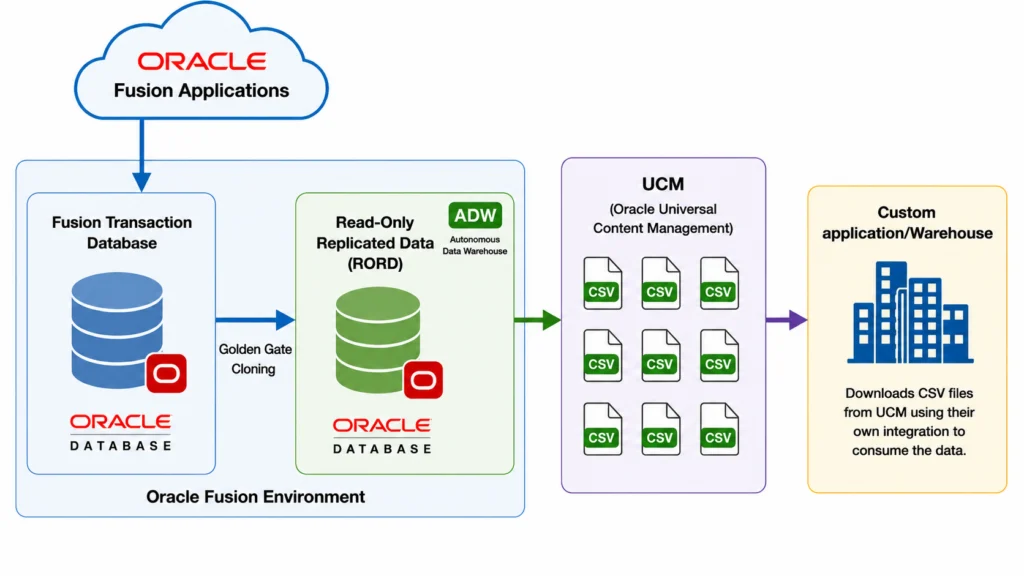
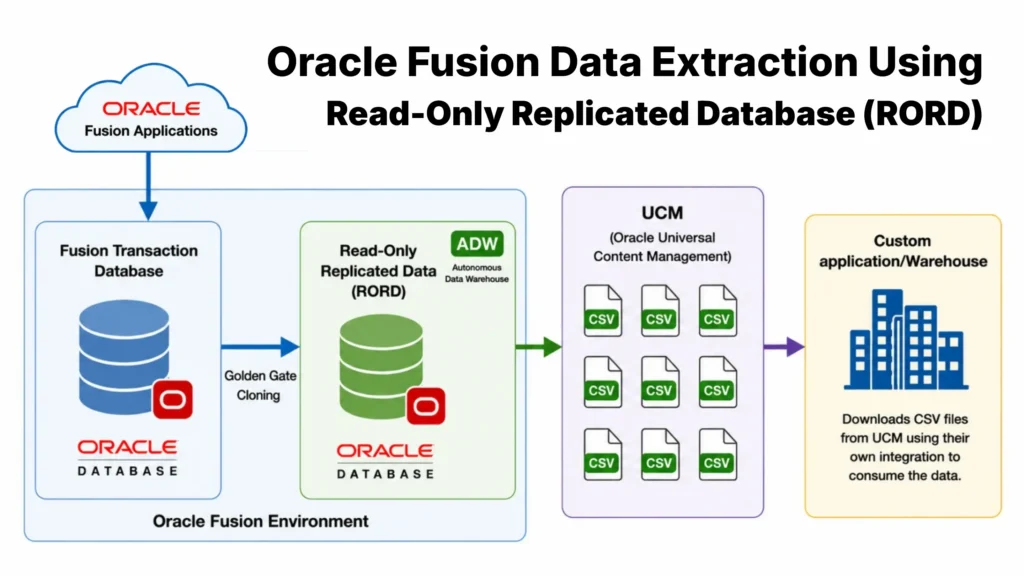
The users will be able to configure data extracts from Oracle Fusion from pre-configured business views at a schedule that users require.
Files will be created on the Oracle Universal Content Management (UCM) server as comma-separated files. Other applications can download these files using their own integration and get this data out as files.
That Sounds Like BICC: So What is Different?
Technically yes, but here are the key differences.
🚀 BICC vs RORD – Data Extraction Comparison
| Feature | 📦 BICC | ⚡ RORD (New) |
|---|---|---|
| Data Source |
Extracts from Oracle Fusion database Impacts production performance |
Extracts from a replicated database (ADW) Zero impact on production Highly scalable & optimized |
| Data Extract Options |
Uses Public View Objects (PVOs) SQL not required |
Uses Business Views SQL not required Simpler business-friendly model |
| Data Recency |
Real-time extract But delays due to scheduling & UCM processing |
Near real-time replicated data Faster availability for analytics |
| Schedule Options | All frequency options available | All frequency options available |
| Output Destination |
UCM Object Storage |
UCM Oracle Object Storage |
| Output Format | CSV (zipped) |
CSV Jason |
| Incremental Extract | Yes | Yes |
What Is It Used For?
Read Optimized Replicated Database (RORD) can have 2 use cases broadly.
 | Data Extraction to External Data Warehouses RORD can be used to extract data for downstream reporting and analytics platforms such as Oracle Autonomous Data Warehouse, Microsoft SQL Server, or any other enterprise data warehouse. Data extraction typically involves additional integration to connect to UCM file server and load the extracted data into the target warehouse. Note: Integration requires identifying and downloading files from UCM, processing the contents, and loading them into the external system. Incremental load handling must also be implemented, which can add complexity. |
 | Data Integration With External Applications RORD can act as a reliable data source for applications integrated with Oracle Fusion. Instead of building custom SQL queries or BI Publisher reports, you can use scheduled extracts to feed data into external systems. For example, if you are developing an application using Oracle APEX on Oracle Autonomous Transaction Processing, you can consume RORD extracts to simplify data access and reduce development effort. Note: RORD approach will take care of only data out of Oracle Fusion. Developers will still have to call |
Also Read: Datafusing CloudSQL vs SQLConnect
Do I Need a Separate License For This?
The Oracle Read-Only Replicated Database feature is included with the Oracle Fusion license and does not require any additional licensing.
Is the Read-Only Replicated Database Fully Available?
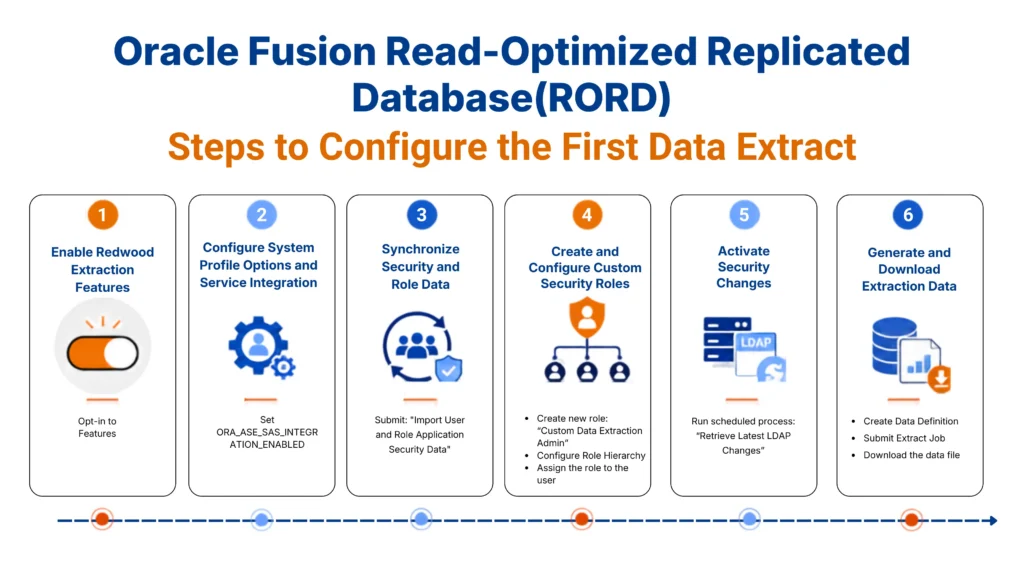
Read-Only Replicated Database is available in 26B ,but with limitations. But as an Opt-in feature. This requires configuration of roles and profile options to start. There are limitations as well
- Language support is only english
- DFFs (Descriptive Flexfields) not included yet
- Business object coverage is still evolving
All in all, this is usable, but not all functionalities are available.
Will This Replace BICC? What Does Oracle Say?
Yes. Oracle is being quite explicit. Read-Only Replicated Database (RORD) will eventually replace:
- Business Intelligence Cloud Connector (BICC)
- BI Publisher (for extract use cases)
Oracle’s Position: “This approach is recommended for all new data extracts and will eventually replace BICC and BI Publisher extracts.”
What Does This Means in Practice?
- ✅ New implementations → Use RORD instead of BICC
- ⚠️ Existing BICC → Plan migration to Read Only Optimized Datastore in the future
- ❌ BICC is effectively legacy now
Also Read: ROI of CloudSQL Desktop for Oracle Fusion Development Teams
Can We Get Direct Database Connection to Read-Only Replicated Database for Quering Oracle Fusion?
No. Read only data store can be accessed through scheduled reports and extracted data. Oracle Fusion Developers still have to use CloudSQL to work with BI reporting, Integration development. Checkout How to run SQLs in CloudSQL in under 5 minutes
Is There a Migration Path From BICC to Read-Only Replicated Data?
No, Oracle has not yet provided a migration path for existing BICC users. Migration will require mapping BICC data stores to the BI Views available in RORD.
Oracle Guidance: Refer to “Map BICC Data to Business Object Data”
Practical Implication: The practical implication is that the migration effort is expected to be medium to high. The migration process will require a strong functional understanding of the existing and target data models, detailed data mapping between BICC data stores and BI Views, and thorough testing to validate the migrated reports and integrations.
In addition, any target systems that currently consume BICC-generated data from UCM will need to be rewritten or modified to support the new integration method.
Also Read: HZ_PARTIES Table in Oracle Fusion