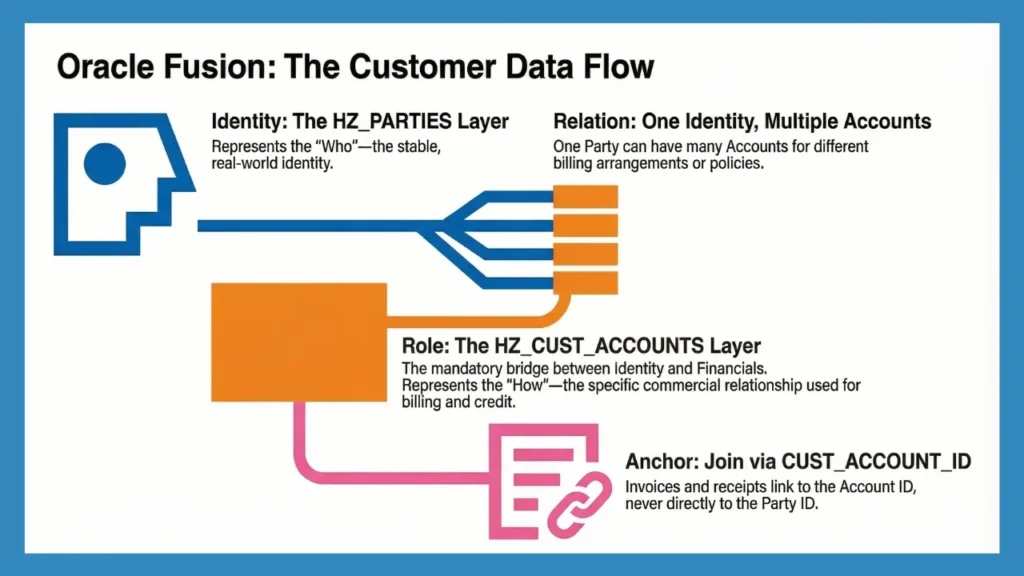
Customer master data forms the foundation of Oracle Fusion Financials, Accounts Receivable, and Supply Chain operations. Every invoice, receipt, and customer-facing transaction ultimately depends on how customer information is modeled at the master data level.
When this model is misunderstood, the resulting issues extend beyond reporting inaccuracies into reconciliation problems and transactional inconsistencies.
A recurring point of confusion in Oracle Fusion is the distinction between a party and a customer account. Although these terms are often used interchangeably, they represent different layers of the data model. Misunderstanding this separation frequently leads to incorrect joins, duplicate customer records, and mismatches between master data and Accounts Receivable transactions.
This blog explains the HZ_CUST_ACCOUNTS table in detail, clarifies how it fits into Trading Community Architecture (TCA), and outlines correct query patterns involving customer accounts.
The goal is to establish a clear mental model for customer data that aligns with how Oracle Fusion is designed to operate.
Where HZ_CUST_ACCOUNTS Fits in Trading Community Architecture (TCA)?
Trading Community Architecture (TCA) is the party-centric data model used by Oracle Fusion to manage shared identity information across applications. Instead of allowing each module to maintain its own version of customers or suppliers, TCA defines identity once and reuses it consistently across functional areas.
Within TCA, HZ_PARTIES stores identity information for real-world entities, while HZ_CUST_ACCOUNTS represents the customer-specific role of that identity. HZ_CUST_ACCOUNTS is not an identity table; it is the customer account layer that enables billing and receivables processing.
From a structural perspective, the relationship can be understood as a clear hierarchy:
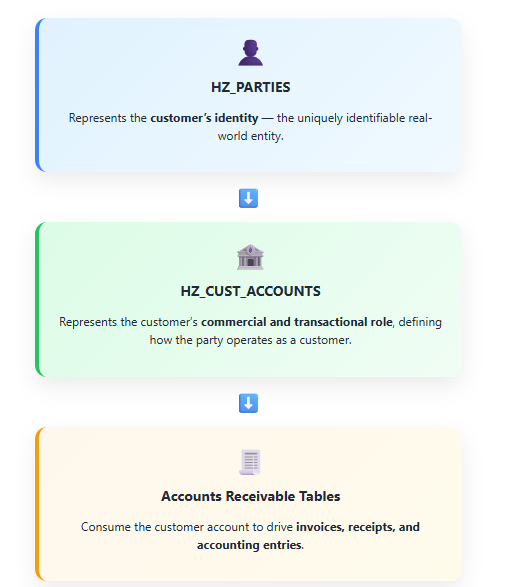
This separation allows identity to remain stable while customer relationships remain flexible. A party can exist without being a customer, and the same party can have multiple customer accounts without duplicating identity data.
What Is the HZ_CUST_ACCOUNTS Table?
The HZ_CUST_ACCOUNTS table stores customer account–level information that defines how a party participates in Oracle Fusion as a customer. Each record represents a single customer account and is uniquely identified by CUST_ACCOUNT_ID.
HZ_CUST_ACCOUNTS contains attributes such as customer account numbers, account status, and classification details required for downstream financial processing. These attributes are intentionally separated from party identity so that commercial behavior can change independently of identity.
A critical principle is that a customer is not the same as a party. The party represents the real-world entity, while the customer account represents a specific commercial relationship.
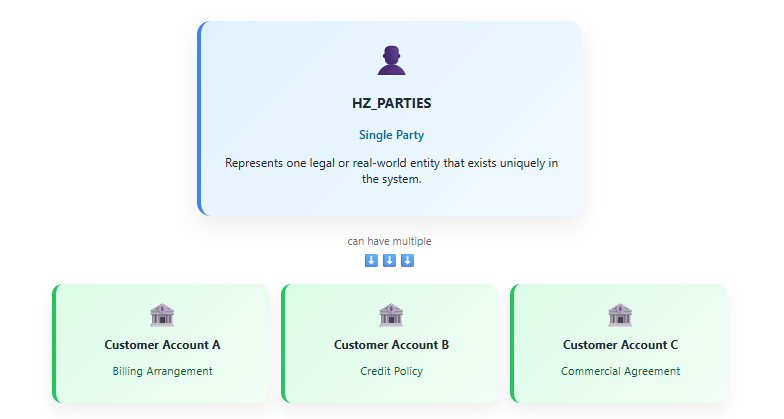
Oracle Fusion supports scenarios where a single party maintains multiple customer accounts, each with its own billing or credit context, while continuing to reference the same PARTY_ID.
| Aspect | Party (HZ_PARTIES) | Customer Account (HZ_CUST_ACCOUNTS) |
|---|---|---|
| Primary purpose | Identity of the real-world entity | Commercial and transactional role |
| Unique identifier | PARTY_ID | CUST_ACCOUNT_ID |
| Transactional usage | Not used directly | Consumed by Accounts Receivable |
| Cardinality | One identity per entity | Multiple accounts per party allowed |
Also Read: HZ_PARTIES Table in Oracle Fusion: Customers, Suppliers & Employees
Role of HZ_CUST_ACCOUNTS in Transaction Processing
From a transactional standpoint, HZ_CUST_ACCOUNTS acts as the entry point for Accounts Receivable. Invoices, receipts, and accounting distributions do not reference HZ_PARTIES directly. Instead, they rely on the customer account to determine how financial activity should be processed and reported.
For this reason, customer master queries that bypass HZ_CUST_ACCOUNTS often produce incomplete or misleading results.
The following query illustrates the foundational structure of the customer account table:
SELECT
    hca.cust_account_id,
    hca.account_number,
    hca.party_id,
    hca.status
FROM
    hz_cust_accounts hca
WHERE
    hca.status = 'A'
;
Key Columns in HZ_CUST_ACCOUNTS
The HZ_CUST_ACCOUNTS table contains many attributes, but only a small set of columns is consistently relevant for customer master reporting, integrations, and Accounts Receivable analysis. These columns define how a customer account is identified, linked to party identity, and consumed by downstream financial processes.
| Column Name | Description |
|---|---|
| CUST_ACCOUNT_ID | The primary key of the customer account and the global identifier used by downstream Accounts Receivable tables to reference the customer account. |
| PARTY_ID | Foreign key linking the customer account to its corresponding party record in HZ_PARTIES, establishing the customer’s identity. |
| ACCOUNT_NUMBER | The business-visible customer account number displayed in the Fusion user interface and commonly used for functional identification. |
| STATUS | Indicates whether the customer account is active or inactive and determines whether the account can be used for transactions. |
| CREATED_BY | Stores the identifier of the user or process that created the customer account record. |
| CREATION_DATE | Stores the date and time when the customer account record was created. |
Among these columns, CUST_ACCOUNT_ID is the most important in transactional contexts. While PARTY_ID establishes identity, Oracle Fusion financial transactions consistently reference the customer account rather than the party. This design allows multiple customer accounts belonging to the same party to behave differently in billing, credit, and receivables processing.
Relationship Between HZ_PARTIES and HZ_CUST_ACCOUNTS
The relationship between HZ_PARTIES and HZ_CUST_ACCOUNTS defines the boundary between customer identity and customer behavior in Oracle Fusion. These two tables work together, but they serve different purposes and must be interpreted accordingly when querying customer data.
HZ_PARTIES answers the question of who the customer is. It stores the stable identity of a real-world entity, such as an organization or person. HZ_CUST_ACCOUNTS answers the question of how that entity operates as a customer. It represents the commercial relationship under which the party participates in financial transactions.
This relationship is established through a simple but critical join condition:
hz_parties.party_id = hz_cust_accounts.party_idFrom a data model perspective, this is a one-to-many relationship. A single party can be associated with multiple customer accounts, while each customer account always belongs to exactly one party.
Oracle Fusion uses this design to support scenarios where the same legal entity maintains separate billing arrangements, credit policies, or commercial agreements.
The distinction becomes clearer when the roles of the two tables are viewed side by side:
| Table | Responsibility |
|---|---|
| HZ_PARTIES | Defines the identity of the customer as a uniquely identifiable entity. |
| HZ_CUST_ACCOUNTS | Defines how that entity functions as a customer for billing and receivables processing. |
Customer queries should always respect this separation by sourcing identity attributes from HZ_PARTIES and account attributes from HZ_CUST_ACCOUNTS.
The following query demonstrates the join pattern used to anchor customer accounts to party identity:
| SELECT hp.party_id, hp.party_name, hca.cust_account_id, hca.account_number, hca.status FROM hz_parties hp, hz_cust_accounts hca WHERE hp.party_id = hca.party_id AND hp.party_type = ‘ORGANIZATION’ AND hca.status = ‘A’ ; |
Understanding Customer Master Data in Oracle Fusion
Customer master data in Oracle Fusion represents the authoritative definition of customers used across Financials, Accounts Receivable, and downstream reporting. Rather than existing as a single table, customer master data is composed of multiple layers that together describe identity, commercial relationships, and operational context.
At the highest level, customer master data combines identity, customer accounts, and supporting structures such as addresses and contacts. Each layer serves a distinct purpose and is intentionally separated to allow customer relationships to evolve without redefining identity.
| Customer Master Component | Role in Oracle Fusion |
|---|---|
| Party (HZ_PARTIES) | Defines the identity of the real-world entity interacting with the enterprise. |
| Customer Account (HZ_CUST_ACCOUNTS) | Defines how that entity operates as a customer for billing and receivables. |
| Addresses and Sites | Define where transactions are billed or shipped. |
| Contacts | Define individuals associated with customer communication and operations. |
Within this lifecycle, HZ_CUST_ACCOUNTS acts as the control point between identity and financial processing. It determines which customer relationships are eligible for invoicing, credit management, and accounting.
Because Accounts Receivable transactions are anchored to customer accounts rather than parties, inaccuracies at the account level directly affect billing, revenue recognition, and reconciliation.
Clean and correctly modeled customer master data is therefore critical for accurate receivables processing, consistent revenue reporting, and reliable cross-module analytics.
Most downstream issues attributed to transactional data can be traced back to misunderstandings or misalignment in customer master data, particularly around how customer accounts are defined and used.
Common Use Cases for HZ_CUST_ACCOUNTS
The HZ_CUST_ACCOUNTS table serves as the primary anchor for customer-related reporting and reconciliation in Oracle Fusion. Because Accounts Receivable transactions reference customer accounts rather than party identity, most customer-centric use cases begin by resolving customer accounts correctly before extending into transactional tables.
The following query represents the canonical customer master pattern, combining party identity with customer account context:
SELECT
    hp.party_id,
    hp.party_name,
    hca.cust_account_id,
    hca.account_number,
    hca.status
FROM
    hz_parties hp,
    hz_cust_accounts hca
WHERE
    hp.party_id = hca.party_id
    AND hp.party_type = 'ORGANIZATION'
    AND hca.status = 'A';
This pattern forms the basis for several common use cases.
| Use Case | Application of the Pattern |
|---|---|
| Customer master reporting | Used to extract the authoritative list of active customer accounts with identity context. |
| Customer account validation | Filtered by ACCOUNT_NUMBER or CUST_ACCOUNT_ID to confirm account existence and status. |
| Accounts Receivable reconciliation | Extended by joining Accounts Receivable tables using CUST_ACCOUNT_ID. |
| Customer data audits | Enhanced with date and status filters to identify inactive or redundant accounts. |
| Cross-module customer analytics | Reused as the identity anchor across Financials and reporting layers. |
Suggested Read: Oracle Fusion Joins Explained
Common Joins Involving HZ_CUST_ACCOUNTS
Queries involving HZ_CUST_ACCOUNTS typically sit at the boundary between customer master data and transactional data. For this reason, join order and join intent matter more than the number of tables involved. A clear separation between identity resolution and transactional extension helps keep results accurate and predictable.
In most customer-centric queries, joins follow a consistent path. Party identity is resolved first, customer account context is applied next, and transactional tables are introduced only when required. This approach mirrors how Oracle Fusion itself evaluates customer data.
Identity to Customer Account
Customer queries should begin by resolving the relationship between party identity and customer accounts. This establishes who the customer is and under which account the customer operates.
SELECT
    hp.party_id,
    hp.party_name,
    hca.cust_account_id,
    hca.account_number,
    hca.status
FROM
    hz_parties hp,
    hz_cust_accounts hca
WHERE
    hp.party_id = hca.party_id
    AND hp.party_type = 'ORGANIZATION'
    AND hca.status = 'A';
This join ensures that identity attributes are sourced from HZ_PARTIES, while account-level attributes are sourced from HZ_CUST_ACCOUNTS, without mixing responsibilities between the two tables.
Customer Account to Accounts Receivable Transactions
Once customer account context is established, Accounts Receivable tables can be joined using CUST_ACCOUNT_ID. Transactions do not reference party identity directly, which makes the customer account the mandatory bridge into receivables data.
SELECT
    hca.cust_account_id,
    hca.account_number,
    rcta.customer_trx_id,
    rcta.trx_number,
    rcta.trx_date,
    rcta.invoice_currency_code
FROM
    hz_cust_accounts hca,
    ra_customer_trx_all rcta
WHERE
    hca.cust_account_id = rcta.bill_to_customer_id
;
This join path reflects how invoices are associated with customers in Oracle Fusion. Bypassing the customer account layer and attempting to join transactions directly to party data introduces ambiguity and often leads to incorrect aggregation.
Common Mistakes Developers Make
In practice, customer-related queries in Oracle Fusion often produce incorrect or misleading results, not because of data complexity, but due to recurring misconceptions around HZ_CUST_ACCOUNTS. These issues typically stem from misunderstanding how identity, customer accounts, and transactions are separated within Trading Community Architecture.
The table below summarizes the most common mistakes encountered when working with HZ_CUST_ACCOUNTS and explains their practical impact.
| Mistake | What Typically Happens | Why It Causes Issues |
|---|---|---|
| Assuming one customer equals one account | Reports return duplicate or unexpected customer rows. | Oracle Fusion allows multiple customer accounts for a single party. |
| Treating PARTY_NAME as unique | Records for different customers are incorrectly merged. | Party names are not enforced as unique identifiers. |
| Ignoring customer account status | Inactive or obsolete accounts appear in financial reports. | Customer accounts are soft-deactivated rather than deleted. |
| Joining transactions directly to parties | Transactions appear mismatched or incomplete. | Accounts Receivable tables reference customer accounts, not parties. |
| Expecting amounts in RA_CUSTOMER_TRX_ALL | Queries fail or return misleading results. | Transaction amounts are stored at line or distribution level, not in the invoice header. |
| Skipping validation against the Fusion UI | Query results do not match application screens. | Incorrect joins can still produce technically valid but functionally incorrect data. |
Performance & Querying Best Practices
Queries involving HZ_CUST_ACCOUNTS often sit at the intersection of master data and high-volume transactional data. Small design choices at the query level can therefore have a disproportionate impact on both performance and result accuracy.
The table below summarizes practices that consistently lead to reliable and efficient customer reporting in Oracle Fusion.
| Best Practice | How It Is Applied | Why It Matters |
|---|---|---|
| Filter by account status early | Restrict queries to active customer accounts unless historical analysis is required. | Inactive accounts remain in the database and can distort financial results if not excluded. |
| Filter by party type | Limit identity joins to ORGANIZATION parties for customer reporting. | HZ_PARTIES stores multiple entity types, and unfiltered joins introduce irrelevant records. |
| Use CUST_ACCOUNT_ID for transactions | Join Accounts Receivable tables using CUST_ACCOUNT_ID only. | Financial transactions are resolved at the customer account level, not the party level. |
| Avoid SELECT * | Select only the columns required for the reporting objective. | Customer and AR tables are wide and unnecessary columns increase I/O and processing cost. |
| Control one-to-many joins | Introduce transactional tables only after resolving customer account context. | Early joins to AR tables can multiply rows and produce misleading aggregates. |
| Validate against the Fusion UI | Cross-check representative records with application screens. | Queries can return technically valid data that does not reflect Fusion’s resolution logic. |
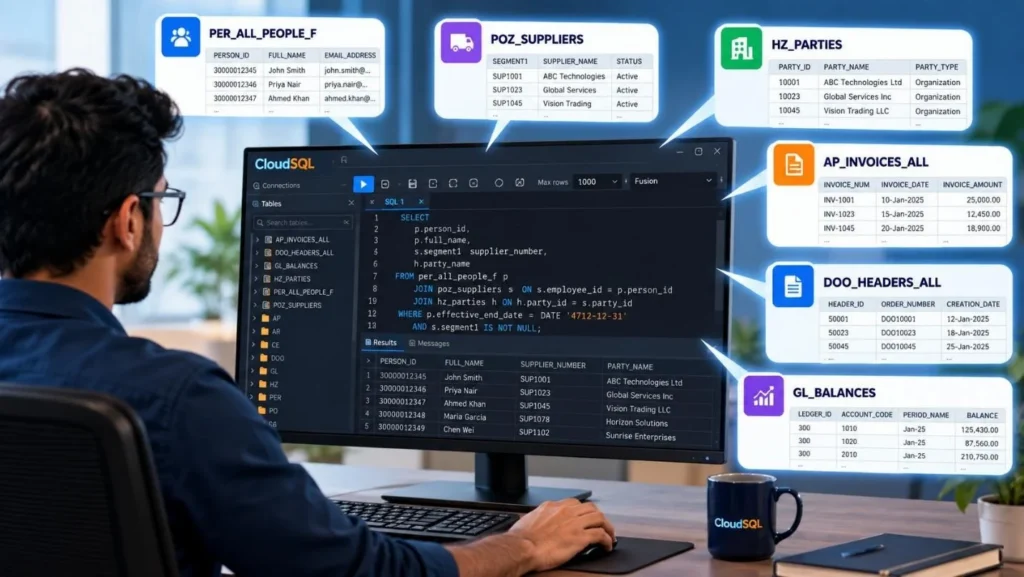
How CloudSQL Simplifies Customer Master Reporting?
Working with customer master data in Oracle Fusion is rarely a single-pass activity. Queries involving HZ_PARTIES, HZ_CUST_ACCOUNTS, and Accounts Receivable tables typically require iteration to validate joins, inspect result sets, and understand one-to-many behavior. Issues such as duplicate rows or unexpected record counts usually become visible only after execution.
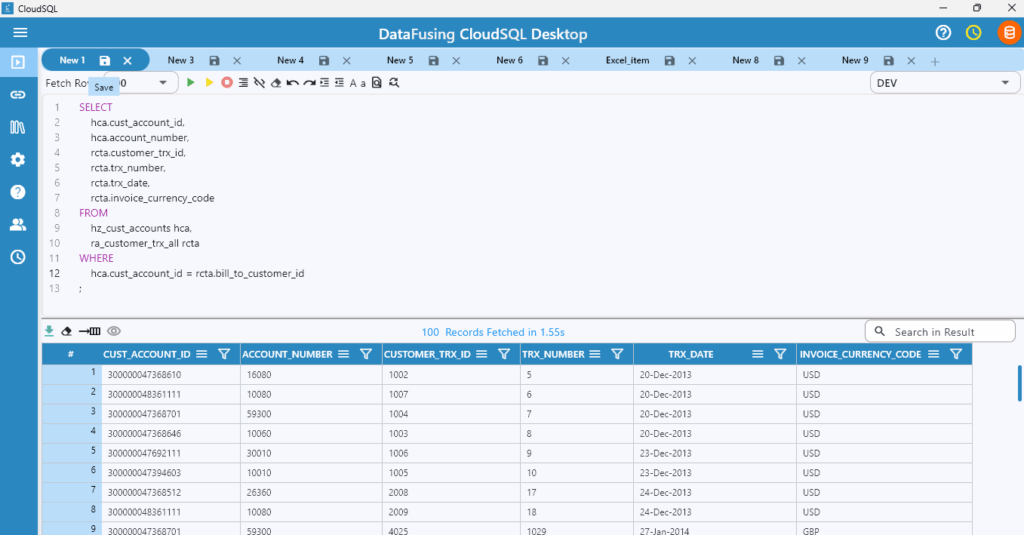
CloudSQL supports this workflow by focusing on efficient SQL authoring, schema awareness, and result inspection rather than attempting to model or enforce business relationships. It does not generate joins, visualize data models, or validate functional correctness. Instead, it accelerates the developer’s ability to explore and reason about customer data.
| Capability | How It Helps with Customer Master Queries |
|---|---|
| Schema exploration | Allows developers to inspect tables and columns such as HZ_CUST_ACCOUNTS and RA_CUSTOMER_TRX_ALL without switching to external documentation. |
| Iterative query execution | Supports repeated execution of customer queries to refine joins and filters based on observed results. |
| Dynamic result grid | Enables sorting, filtering, and searching within result sets to identify duplicate rows or unexpected one-to-many behavior. |
| Column-level inspection | Helps navigate wide tables by quickly locating relevant customer account and transaction attributes. |
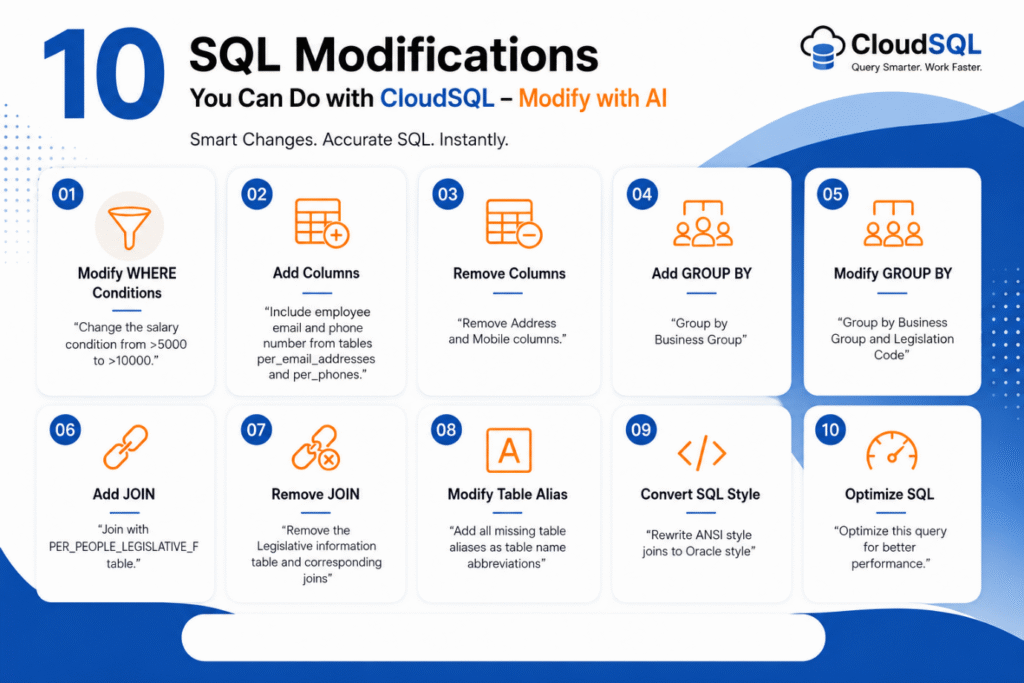
| AI-assisted SQL correction | Uses AI to help identify and fix syntax, aliasing, or structural SQL issues during query authoring, without interpreting business logic. |
This approach is particularly useful when validating customer master extracts or reconciling Accounts Receivable data, where correctness depends on understanding how customer accounts relate to transactions rather than on automated validation.
By reducing friction in SQL authoring and result analysis, CloudSQL helps developers focus on interpreting customer data accurately within Oracle Fusion’s data model.
When to Extend Beyond HZ_CUST_ACCOUNTS?
HZ_CUST_ACCOUNTS defines how a party functions as a customer, but Oracle Fusion deliberately avoids storing related operational details directly in the customer account table. This separation keeps customer accounts stable while allowing addresses, transactions, and payment activity to evolve independently.
Reporting and analysis typically extend beyond HZ_CUST_ACCOUNTS when additional context is required, such as billing locations or financial activity. In these cases, customer accounts act as the starting point rather than the final destination.
| Related Table | Purpose |
|---|---|
| HZ_CUST_ACCT_SITES_ALL | Stores customer account site information used to associate accounts with billing and shipping locations. |
| HZ_LOCATIONS | Stores address details referenced by customer account sites. |
| RA_CUSTOMER_TRX_ALL | Stores Accounts Receivable transaction headers linked to customer accounts. |
| AR_CASH_RECEIPTS_ALL | Stores receipt information applied against customer accounts. |
Each of these tables extends customer context in a specific direction. Account sites and locations add geographical and operational detail, while Accounts Receivable tables add financial activity. Introducing these tables should be driven by reporting requirements rather than by default, as each extension increases result set complexity.
When deeper analysis is required, understanding where HZ_CUST_ACCOUNTS stops and where other tables begin helps maintain clarity and prevents customer master queries from becoming unnecessarily complex.
Conclusion
HZ_CUST_ACCOUNTS represents the point at which customer identity becomes a transactional reality in Oracle Fusion. While HZ_PARTIES defines who a customer is, HZ_CUST_ACCOUNTS defines how that entity participates in financial processes such as billing, invoicing, and receivables management. Understanding this distinction is essential for accurate customer reporting and reliable Accounts Receivable analysis.
Most customer data issues in Oracle Fusion are not caused by transactional complexity, but by incorrect assumptions about where customer context is stored. Treating HZ_CUST_ACCOUNTS as the authoritative customer reference, respecting its relationship with party identity, and extending into transactional tables only when required helps avoid many common reconciliation and reporting errors.
For teams working extensively with Oracle Fusion customer data, adopting a structured approach to querying customer accounts reduces ambiguity and improves confidence in analytical results.
Exploring customer master data with the right tools and a clear understanding of the underlying model enables faster analysis and more consistent outcomes across Financials and reporting environments.
Must Read: Top 10 Oracle Fusion SQL Mistakes Developers Make
FAQs
What is HZ_CUST_ACCOUNTS in Oracle Fusion?
HZ_CUST_ACCOUNTS is the core customer account table in Oracle Fusion that defines how a party participates as a customer in financial and receivables processes. It stores customer account–specific attributes such as account number and status and acts as the primary reference point for Accounts Receivable transactions. The table does not store identity information; it represents the commercial customer relationship required for billing and accounting.
How is HZ_CUST_ACCOUNTS related to HZ_PARTIES?
HZ_CUST_ACCOUNTS is linked to HZ_PARTIES through the PARTY_ID column. HZ_PARTIES defines the identity of the real-world entity, while HZ_CUST_ACCOUNTS defines how that entity operates as a customer. This separation allows Oracle Fusion to reuse a single identity across multiple business roles while maintaining distinct customer account contexts for financial processing.
Can one party have multiple customer accounts?
Yes. Oracle Fusion allows a single party to be associated with multiple customer accounts. This supports business scenarios where the same legal entity maintains separate billing arrangements, credit profiles, or commercial relationships. Each customer account is stored as a separate record in HZ_CUST_ACCOUNTS, while all accounts continue to reference the same PARTY_ID to preserve a single, consistent identity.