Oracle Transactional Business Intelligence (OTBI) is a self-service reporting and analytics tool within Oracle Fusion that lets users create real-time reports and dashboards directly from live transactional data.
While OTBI offers several advantages, it also has certain limitations that should be considered:
- Limited Subject Area Coverage: Access is restricted to predefined subject areas, which may not include all required tables or fields.
- No Direct Access to Back-End Tables: Users cannot query database tables or views directly, which limits their ability to perform complex joins or retrieve real-time custom data.
- Performance Challenges with Large Datasets: Query execution time may increase significantly when working with high-volume data.
- Restricted Data Modeling Flexibility: OTBI offers limited options for creating complex data models beyond the available subject areas.
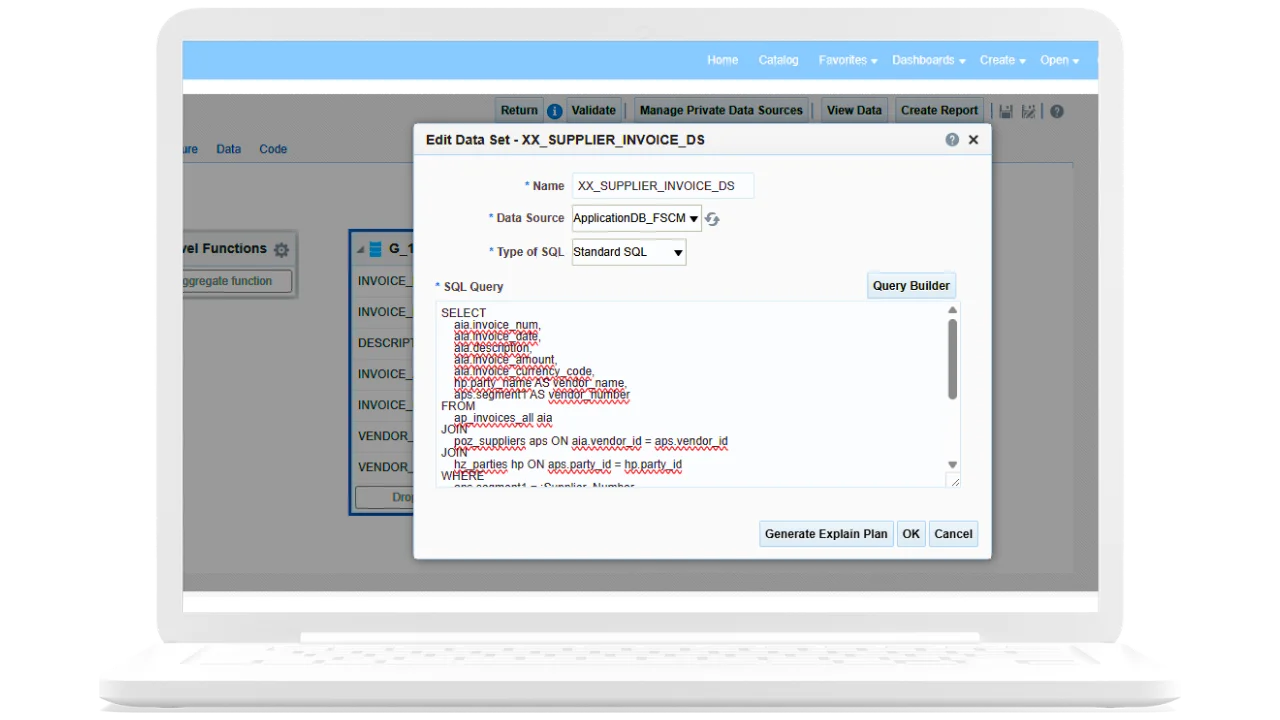
An alternative to OTBI is BI Reporting, which addresses many of the above limitations by allowing users to write SQL queries, join multiple tables, and export results in various formats such as Excel, PDF, or HTML.
Also Read: Building a Custom Report Using Reporting Tools in Oracle Fusion
However, BI Reporting comes with its own challenges; the SQL editor window is inconveniently small, the process of generating a report involves multiple cumbersome steps, and the execution time for reports can be painfully slow.
This is where CloudSQL Desktop changes the game. With CloudSQL Desktop, you can write ad-hoc SQL queries and access real-time data instantly with just a click. For larger datasets, it even supports background execution, so you can continue working without having to wait for the query to be completed.
While OTBI and BI Reporting each have their place, they often leave users wishing for faster, more intuitive ways to access and work with data. CloudSQL Desktop bridges that gap, delivering real-time results, seamless SQL query writing, and effortless exports, all in one streamlined interface
Why Many Choose Alternative Reporting Over OTBI?
OTBI’s limitations are not just technical specs; they show up in everyday frustrations shared by real users.
One user on Reddit put it bluntly:
“I’ve been dreading having to figure out how to do that through a web UI…”
Another shared their challenge with multi-source data:
“Currently trying to build a report that requires me to use two separate subject areas… Oracle doesn’t play nicely across subject areas.”
And it’s not just about user interface hurdles. Analysts often hit walls when they need to combine data from different subject areas or access fields that simply are not available in OTBI yet.
Also Read: Oracle Fusion Ad Hoc Reporting Made Easy with CloudSQL
What Does “Reporting Without OTBI” Look Like?
Here is how working with CloudSQL to extract Oracle Fusion data looks like. Get the data as soon as you have the SQL ready.

Advantages of SQL-Based Reporting vs OTBI
- Flexibility: Direct SQL access gives you complete control over your queries, allowing ad-hoc joins across multiple tables without being limited to predefined subject areas.
- Performance: Handles large datasets efficiently, with benchmarks showing results in under three minutes even for hundreds of thousands of rows.
- Excel Compatibility: Seamlessly export data into Excel for further analysis, making it easy for business users to work with familiar tools.
- Self-Service Access: Empowers business users to run their own queries and generate reports without relying heavily on IT teams.
Want to see the exact process of building SQL reports without OTBI and BI Publisher? We have created a complete step-by-step tutorial to build SQL reports without OTBI and BI Publisher.
Also Read: Running Your First SQL with CloudSQL
Common Use-Cases
Bank Accounts Duplication Analysis
A U.S.-headquartered financial services firm with 5,000+ employees across 40 countries processes both expenses and salaries through Oracle Fusion. Over time, duplicate banks and branches were created by AP clerks and HCM staff, making data unmanageable.
To cleanse and prevent duplicates, analysts needed SQLs with fuzzy logic to identify similar records. CloudSQL Desktop helps them quickly build and run these SQLs, making the analysis faster, accurate, and easier to manage.
Procurement: Supplier-Level Invoice Analysis
An engineering firm in France set up a custom rule so customer invoices are paid only after related supplier invoices are cleared, tracked using Descriptive Flexfields. When subcontractors complained of delays, the business needed visibility into supplier invoices held back due to partial customer payments.
With CloudSQL Desktop, the IT team can quickly build the SQL logic, test queries interactively, and generate the custom BI Publisher report, saving time and ensuring accurate insights for faster resolution.
Data Migration Reconciliation
A Saudi Arabian oil and gas company acquired a smaller firm in Egypt, adding 200 employees to the HR system via HDL. To reconcile the load, the business needed an ad hoc extract of only the newly added employees from a provided list.
With CloudSQL Desktop, the data migration analyst quickly built the SQL, exported results to Excel, and used VLOOKUPs for validation, ensuring accurate reconciliation in a fraction of the time.
Limitations to Be Aware Of
While SQL-based reporting offers significant advantages, there are a few considerations to keep in mind:
- Permissions & Data Model Knowledge: Direct SQL access requires the right permissions and a working understanding of the Oracle Fusion data model.
- User Training: Teams may need initial training to write queries effectively and avoid common pitfalls.
- Governance & Access Control: Proper governance is essential to ensure data security, manage permissions, and prevent unauthorized access to sensitive information.
Also Read: Self‑Service SQL for Oracle Fusion: Enable Business Users
Frequently Asked Questions (FAQs)
Can I still use OTBI if I choose SQL reporting?
Yes. OTBI is best for out-of-the-box subject areas and quick dashboards. You can complement it with CloudSQL for ad hoc query analysis and custom BI report development tailored to specific business scenarios.
Can I export large data sets easily to Excel?
Yes. Large data sets can be exported seamlessly, as downloads run in the background. With SQL tuning, developers can further optimize performance for faster results.
Do I need to know SQL to get started?
Only the basics are enough. With CloudSQL complemented with AI assisted tools, even complex requirements can be converted into SQL quickly and accurately.