Exporting data from Oracle Fusion Cloud can be difficult when working with large amounts of data. The built-in export option is limited to 20,000 rows. And this requires manual steps every time. This will be fine for small reports, but it is not practical when it comes to handling a large volume of data. Businesses often look for better ways of handling Oracle Fusion data export to Excel, especially when dealing with millions of rows.
With CloudSQL, you don’t have to worry about the 20,000-row export limit in Fusion Cloud. It allows you to export all your data at once and use SQL to filter or customize the information as needed.
The results can be directly opened in Excel, making the process quicker and easier than using the standard export method. This gives users more flexibility and control over their data.
Built-In Export in Oracle Fusion: Why is It Limited?
Oracle Fusion gives us a click-to-export option in many modules. It looks easy and works okay when we need a quick snapshot. But when we go a little deeper, we can see some big limits:
- Row Limit: By default, it only allows around 20,000 rows in one export. If our data is bigger than that, it just stops and puts a note saying not all rows got exported.
- Only What You See: It exports only the columns and rows we can see on the table at that time. Sorting will come in Excel, but grouping or hidden notes will not be there.
- No Joining Across Modules: We cannot mix data from different modules or keep table relations. It only gives a flat table from one place.
- No Automation: There is no simple way to schedule or auto-export. Every time we need to do the work again manually.
Another big limitation is what gets exported. The system only takes the data you can see in the table view. So, if you do some sorting or filtering, that part will come, but hidden columns or extra notes will not be included in the file.
At the end of the day, it’s just a small snapshot, not the full proper data extract. For businesses relying heavily on Oracle Fusion data export to Excel, these limits become frustrating.
Also Read: ChatGPT for SQL? 4 Must-Know Tips for Oracle Developers
Exporting with SQL-Level Tools: The Better Way
SQL-based tools like CloudSQL offer a powerful alternative to the limited built-in export functionality in Oracle Fusion. These tools provide direct access to underlying Fusion Cloud tables, enabling users to work with data at a much deeper level and implement self‑service SQL for Oracle Fusion without depending on IT.
With CloudSQL, you can:
- Run Complex Queries: Retrieve data across multiple modules with full SQL syntax, allowing for joins, aggregations, and filters.
- Export Large Volumes of Data: Unlike the built-in export, which limits output to around 20,000 rows, CloudSQL supports exporting millions of records without restriction.
- Improve Efficiency: Features like SQL code auto-completion and background execution streamline the querying process and enhance productivity.
- Flexible Output Options: Export results in user-friendly formats such as Excel or CSV, ready for immediate analysis or reporting.
This level of flexibility and control makes SQL-based tools an ideal choice for users needing robust, large-scale Oracle Fusion data export to Excel. If you are starting fresh, check out running SQL first with CloudSQL to understand the basics.
Oracle BI Publisher vs CloudSQL: Export Comparison
BI Publisher Export Methods
In Oracle BI Publisher, exporting data typically involves several steps: creating or modifying a data model, configuring a report through the Report Wizard, and then executing an export. While powerful, this process is often manual and may require technical expertise to design and maintain effectively.
CloudSQL Export Approach
CloudSQL streamlines the export process with a simple point-and-click interface. Users can execute queries in the background and download results directly in Excel, reducing complexity and eliminating the need for multiple configuration steps.
This approach not only saves time but also makes data exports accessible to a wider range of users, regardless of technical skill level.
Also Read: Master Oracle BI SQL: 5 Tips to Write Faster, Smarter Queries
Pros & Cons Table: CloudSQL vs Manual Fusion Exports vs Oracle BI Publisher
| Method | Pros | Cons |
| Fusion Export (GUI) | Quick small exports | Row limits (~20k), manual, no joins |
| Oracle BI Publisher | Flexible export formats | Technical, too many steps, memory issue for large records |
| CloudSQL | Unlimited row export, Excel/BI output, query scheduling, drag-and-drop | Requires initial setup, user training |
Use Cases & Personas
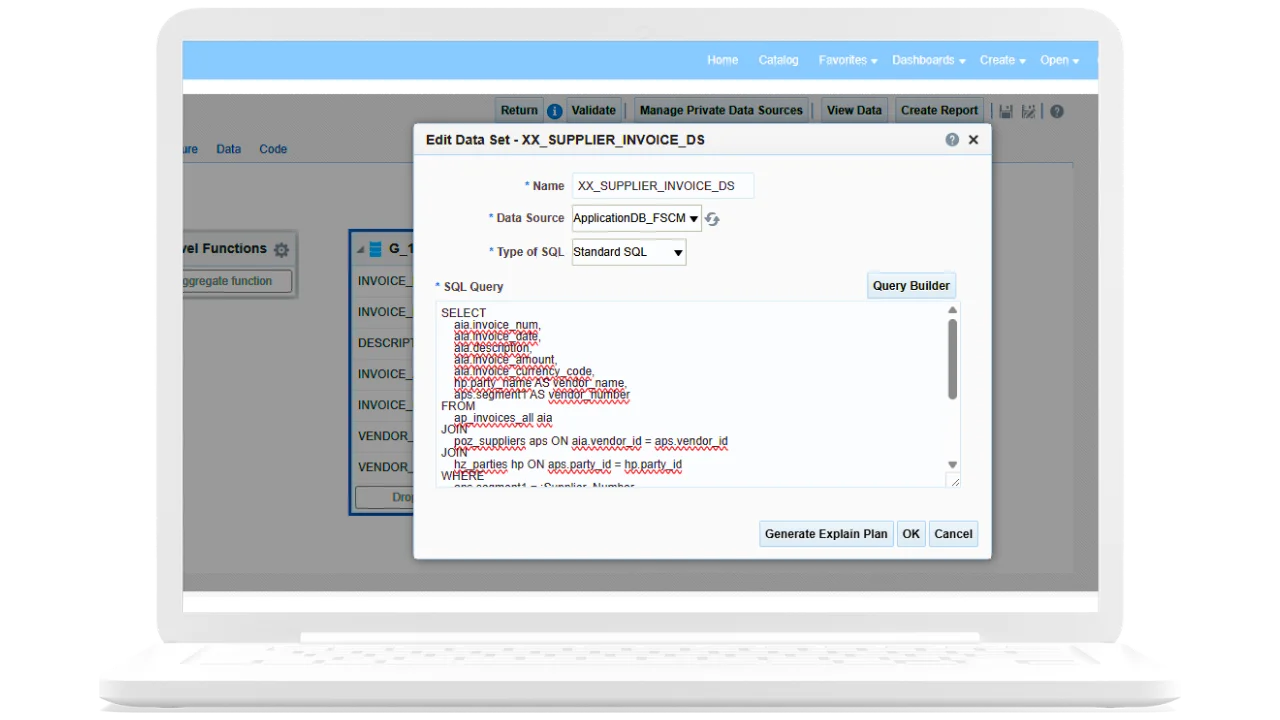
Finance Teams: For the finance team, there is already one report available, but it doesn’t have all the fields they need for full GL reconciliation. The SQL behind that report needs to be modified and extra fields added. After that change, finance can get the full data in a single-click Excel export.
Analytics Teams: The analytics team also depends on the same report. They need a large dataset for sending into BI tools like Power BI or Tableau. The existing report is already there, but a few important columns are missing. Once the IT team updates the SQL and adds those fields, the analytics team can also download the complete data with a one-click export.
For both teams, a strong Oracle Fusion data export to Excel process ensures accuracy and time savings.
Also Read: Effortless Logins: Try SSO with CloudSQL Desktop Today
Common Export Challenges & Solutions
- Large Data Sets: Fusion’s graphical interface has practical limits, typically capping exports at around 20,000 rows. In contrast, CloudSQL is designed to handle significantly larger datasets through background execution, enabling smooth and efficient exports without user intervention.
- Role-Based Access: Exporting data often requires the right permissions. With BI Publisher, this can mean assigning specific roles or relying on shared credentials. Establishing clear role-based access controls ensures security while minimizing delays in obtaining the data needed.
- Formatting and Encoding: Different tools handle formatting in distinct ways. CloudSQL simplifies the process by supporting Unicode directly in Excel exports, ensuring multilingual compatibility. By comparison, SQL Developer frequently generates CSV files that may require additional manual conversion to meet formatting or encoding requirements.
By using CloudSQL, organizations can finally streamline Oracle Fusion data export to Excel and eliminate the repetitive manual effort involved.
Also Read: Oracle Fusion Reporting Without OTBI: Faster Reporting via CloudSQL
Frequently Asked Questions (FAQs)
How many rows can Fusion’s built-in export handle?
20k rows by default
Can CloudSQL export hundreds of thousands of rows reliably?
Yes, with the help of CloudSQL’s background execution and background export, hundreds of thousands of rows can be exported
Does CloudSQL require SQL knowledge to export data?
Yes, basic SQL knowledge is required
Is the Excel export secure within the Fusion environment?
Yes. Any access from CloudSQL adheres to Oracle Fusion’s role-based access control.