In most businesses, including those with Oracle Fusion implemented, there are situations where teams require quick, one-time reports. For example, the finance team may need to investigate account mismatches, or procurement may need to review pending invoices. These types of requests are often not available within standard Oracle Fusion dashboards or even in custom reports developed by the IT team for day-to-day operations.
CloudSQL enables Oracle Fusion Ad Hoc reporting that empowers users to generate data instantly without waiting for IT.
Such requests are passed to IT, who then develop BI Publisher reports using SQL and provide them to the business. This process often gets delayed by having to go through the full report development life cycle—from SQL development to BI data model creation to report layout development. This frequently causes considerable delays in ad hoc reports and, where the report is time-bound, defeats the purpose.
CloudSQL addresses this gap by providing a modern, SQL-based solution that enables developers and power users to create fast, customized reports directly from Oracle Fusion. All that is required is to write your SQL, click once, and the data will be available in Excel or CSV as requested. For more tech-savvy business users, this can often be done by themselves.
What Is Ad Hoc Reporting in the Fusion Context?
Ad hoc reporting is about creating quick, on-demand reports to meet a specific need. Unlike regular monthly reports, these are used to answer immediate business questions. For example, a company might want to pull a list of all invoices from a supplier for the past month or check which employees recently joined but do not yet have payroll records.
OTBI gives some ad hoc options with subject areas and dashboards, but it has limits. Reports only go till 65,000 rows, and Excel export is capped at 25,000 rows or 50,000 cells, so big datasets become hard to handle. BI Publisher is good for scheduled, formatted reports, but it’s not made for quick and flexible queries on the spot.
Why Built-In Tools Fall Short?
OTBI is useful for pulling reports, but it has some big drawbacks. It works slowly when you try to run large or complex queries, and its subject areas are very rigid. You can’t easily join data from multiple modules, so if you want a full picture of your business data, it often becomes frustrating. For dynamic or fast-changing needs, OTBI just doesn’t perform well.
BI Publisher is great when you need pixel-perfect reports like payslips, invoices, or other fixed layouts. But it is not really built for interactive or ad hoc analysis. Users who want to explore data on the fly will find it limiting because it works more like a batch report generator than a flexible reporting tool.
Smart View is often preferred by finance teams because it integrates directly with Excel, making it familiar and easy to adopt. However, its strength is also its limitation. Since it is heavily template-driven and manual, users typically rely on pre-built queries or templates rather than exploring data freely. This means that if business requirements change, users may need to repeatedly adjust or rebuild templates, which slows down decision-making.
Additionally, Smart View is not designed for real-time or dynamic querying. It works best when pulling periodic reports, but for ad hoc analysis or complex, cross-module data exploration, it can feel restrictive and time-consuming.
OTBI and BI Publisher fall short for dynamic analysis, especially when performing Oracle Fusion data export to Excel via SQL for large datasets.
Also Read: Self‑Service SQL for Oracle Fusion: Enable Business Users
How CloudSQL Delivers Real Ad Hoc Reporting?
CloudSQL Desktop is a modern SQL editor built on top of the same Oracle BI APIs but designed to be far more efficient and user-friendly than native tools. It gives business and technical users the flexibility to run real ad hoc analysis without the limitations of rigid templates or slow performance.
CloudSQL Desktop gives business and technical users the flexibility to run Oracle Fusion Ad Hoc reporting without the limitations of rigid templates or slow performance.
Key Features of CloudSQL Desktop
- One-Click Execution: Instantly run queries with minimal setup.
- SQL Auto-Complete: Intelligent suggestions to reduce errors and speed up query writing.
- Lightning-Fast Performance: Optimized for large datasets and complex joins.
- Intelligent Error Assistance: Clear guidance to resolve SQL issues quickly.
- AI-Enhanced Query Help: Automatically improve or debug problematic SQL.
- Bind Variable Support: Run parameterized queries securely and efficiently.
- Spreadsheet Integration: Export results directly to Excel and seamlessly connect outputs to Power BI or Tableau for advanced visualization.
With these capabilities, CloudSQL Desktop empowers users to move beyond static reports and truly explore Oracle Fusion data in real time, driving faster insights and smarter decision-making. For beginners, you can also check running first SQL with CloudSQL to get started quickly
Why CloudSQL for Ad Hoc Queries Wins?
| Benefit | CloudSQL | BI Publisher Connect |
| User Interface | Rich SQL editor with syntax highlighting, formatting, and auto-completion | Basic text editor |
| Connection | Uses Oracle Fusion credentials with full role-based security | Uses Oracle Fusion credentials |
| SQL Execution | Single-click data retrieval | Requires full BI report creation, more time-consuming |
| Result Analysis | Interactive result grid with search, sort, and filter | Must export to external tools for analysis |
| Database Structure Lookup | Built-in database browser | Requires switching back and forth to Oracle documentation |
| SQL Error Analysis | Smart error analysis with AI-assisted fixes | Only basic error messages provided |
| Code Management | SQL history saved automatically, with options to search and reuse | No built-in code management |
| Price | $20/month subscription | Included in Oracle Fusion subscription |
Also Read: How to Connect to Oracle Fusion Database for SQL Queries?
Common Use Cases
Finance Teams: For the finance team, investigating account mismatches during the month-end close is a common requirement. While there is already a report available, it does not include all the fields needed for a complete investigation. The typical solution would be to modify the existing report and add more columns, but this would unnecessarily trigger a full development cycle for what is essentially a one-time need.
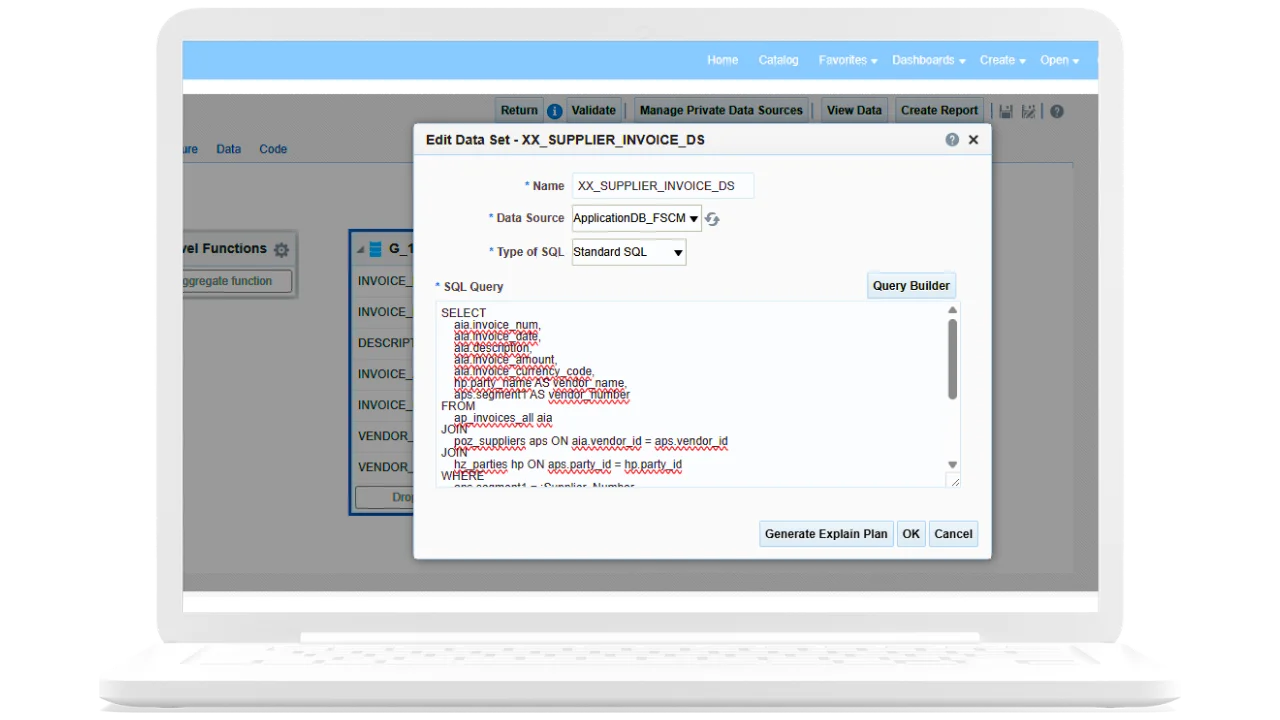
Instead, the alternative is to extract the SQL behind the report, edit it in CloudSQL to include the required columns, execute it with a single click, and then export the results to Excel.
Analytics Teams: A parts manufacturer in the United States has implemented Oracle Cloud for finance and Salesforce for managing sales. The analytics team needs a large dataset to feed into Power BI for ad hoc analysis and reporting on sales trends, combining data from both Oracle and Salesforce.
For Oracle data, an existing AR invoice report is available, but it is restricted by mandatory parameters. Instead of modifying the report, the SQL can be extracted from the existing report, edited in CloudSQL to remove the parameters, and then executed with a single click. The results can be exported to Excel and seamlessly loaded into Power BI.
Troubleshooting Ad Hoc Query Issues
Even with advanced tools, ad hoc reporting can sometimes face challenges.
Common BI Publisher Failure Scenarios
- Timeouts: Reports often fail if execution takes longer than 5 minutes.
- Maximum Report Size: BI Publisher limits the volume of data returned, resulting in incomplete outputs for large queries.
CloudSQL-Specific Tips
While CloudSQL is designed to overcome BI limitations, following a few best practices will help ensure smooth performance:
- Start with a template SQL: There’s no need to build queries from scratch. Extract SQL from an existing standard or custom report and use it as a starting point for editing.
- Use fetch count effectively: When testing your SQL, set the fetch count to a smaller value (e.g., 10 or 100) to speed up iterations. Switch to All rows only when your SQL is finalized.
- Background execution: Use CloudSQL’s background execution feature for queries that are expected to take longer to run.
Also Read: Oracle Fusion Reporting Without OTBI: Faster Reporting via CloudSQL
Frequently Asked Questions (FAQs)
What qualifies as ad hoc reporting in Fusion?
Ad hoc reporting in Fusion means creating a one-time report or data extract for a specific business requirement, such as a data-based investigation or reconciliation.
Can CloudSQL handle large or complex ad hoc queries?
Yes. With its intelligent SQL Editor, CloudSQL is designed to handle large or complex ad hoc queries. You get the benefit of SQL syntax highlighting, SQL formatting, single-click execution, and AI-based error fixing.
Is SQL knowledge required?
Yes, basic SQL knowledge is required to build and run queries in CloudSQL.
How do I share ad hoc query outputs?
You can export outputs to Excel or CSV, depending on your needs.
Can I run ad hoc queries in the background?
Yes, CloudSQL allows you to run SQL queries in the background while you continue working.