Business teams often rely on scheduled reports delivered by IT or analytics teams. While these reports serve many routine needs, there are times when teams require on-demand access to data, the flexibility to explore, filter, and extract information as needed, without always having to wait for IT support.
This is where self-service SQL for Oracle Fusion becomes essential. It empowers business users with faster access, better control, and flexibility to work with live data directly.
Oracle Fusion offers two main tools for this:
- OTBI (Oracle Transactional Business Intelligence)
- Oracle BI Publisher (standard or custom reports)
While OTBI is easy to use and integrates well with the application, it has limitations when it comes to complex data requirements. For power business users who need to write SQL queries, whether for detailed joins, calculated fields, or customized outputs, OTBI often falls short.
Also Read: Oracle Fusion Reporting Without OTBI: Faster Reporting via CloudSQL
The Challenges of SQL Access in Oracle Fusion
Here’s where things get tricky:
- Direct access to the Oracle Fusion database is restricted. Tools like SQL Developer or Toad can’t connect to Fusion’s cloud-hosted environment.
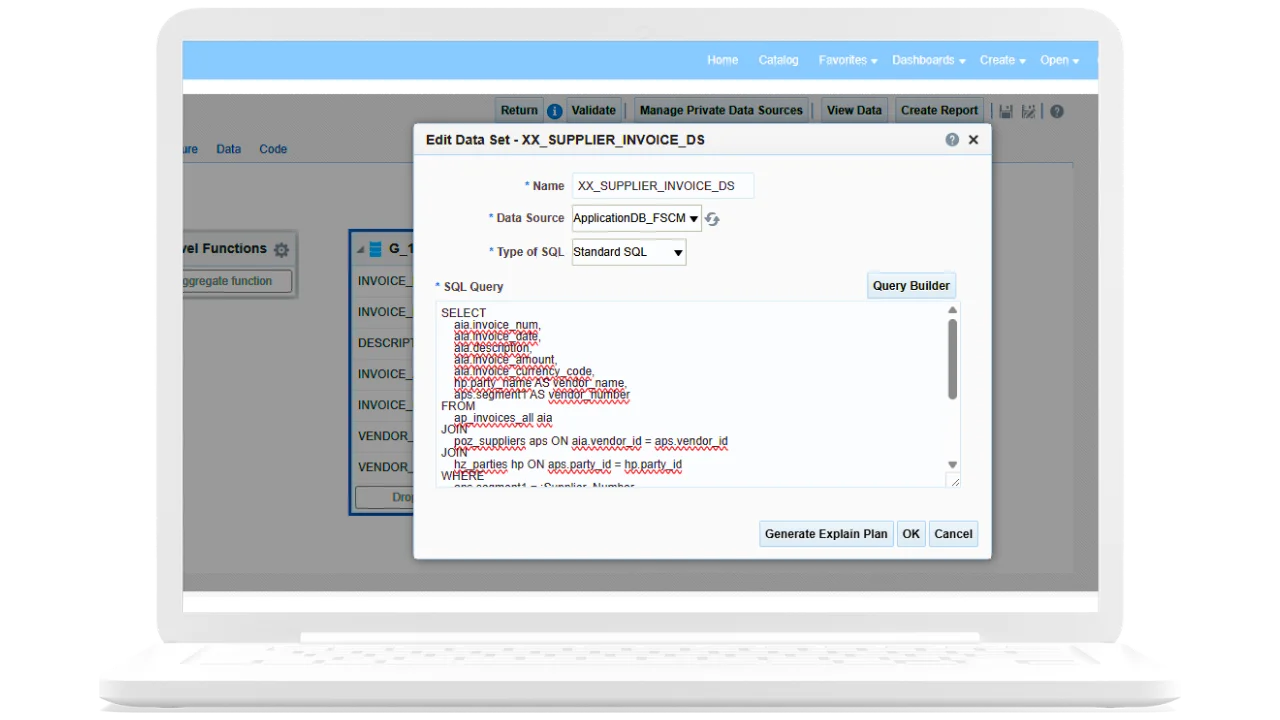
- BI Publisher does allow SQL queries through data models, but:
- The SQL editor is not user-friendly, and the interface is small and limiting. Building a usable report requires navigating several steps, which can be cumbersome for non-technical users.
- The process can be time-consuming, especially for quick ad hoc needs.
In short, while the platform supports SQL in theory, using it effectively requires technical knowledge and patience, making it less ideal for power business users who just need quick, flexible access to their data.
While CloudSQL doesn’t offer a fully self-service SQL experience, it significantly simplifies the development process for users who need to write queries. Its built-in database browser, code auto-completion, and intelligent error assistance make it easier for business users and analysts to explore data and build queries more efficiently.
CloudSQL provides a secure and streamlined environment for SQL-based reporting, offering a practical and scalable solution for organizations looking to empower their teams with more flexible data access, without compromising on governance or security.
If you want a detailed walkthrough, check out this guide on running your first SQL with CloudSQL.
Also Read: From Oracle E-Business Suite to Oracle Fusion: 5 Key Differences Every Oracle Developer Should Know

What Does “Self-service SQL” Mean for Fusion Users?
For many business users, self-service SQL for Oracle Fusion means having the ability to run their own data queries directly and securely without needing to rely on IT or wait for a new report to be built.
Imagine a Scenario
A business user wants to check for duplicate customer names and accounts in Oracle Fusion. This is a simple, one-time check that isn’t covered by any existing report or dashboard. Waiting for a new report to be developed or manually digging through Excel exports is inefficient and frustrating.
How Current Options Fall Short?
- OTBI (Oracle Transactional Business Intelligence): While user-friendly, OTBI has limited data access and rigid reporting formats, making it unsuitable for more complex or exploratory queries.
- BI Publisher: Offers powerful reporting through SQL-based data models but comes with significant technical overhead, from writing and testing queries to configuring data models and layouts. Configuring report layout is very tedious even for a simple table layout. BI publisher can not easily accommodate adding and removing more columns.
- Excel Exports: A common workaround is to extract data from multiple BI reports into Excel and then merge them using VLOOKUP. However, this approach is manual, prone to frequent rework and formula errors, and often results in data inconsistencies when reports are not generated in sync.
Also Read: How to Extract All User Details from Oracle Fusion?
Why CloudSQL Fills This Gap?
This is where CloudSQL proves to be a practical solution. Unlike traditional tools that require setup or technical configuration, CloudSQL offers a lightweight, accessible SQL editor for Oracle Fusion, available via web or desktop, with no installation or JDK required.
It’s designed to make SQL development easier, even for business users or analysts who aren’t full-time developers.
Key Features That Simplify SQL Development
- Database Browser: Quickly explore tables, columns, and relationships within the Oracle Fusion data model.
- Code Auto-Completion: Speed up query writing with intelligent suggestions for table names, columns, functions, and syntax.
- SQL Library Integration: Access ready-to-use SQL snippets from CloudSQL Online, a great starting point for common use cases.
- AI-Assisted SQL Generation: Use any AI tool to generate a base SQL query and then refine and run it within CloudSQL’s intuitive interface.
CloudSQL bridges the gap between power and usability, giving business users the flexibility of SQL without the complexity of traditional development environments. For anyone looking to connect to Oracle Fusion Database for SQL Queries, CloudSQL makes the process fast, secure, and user-friendly.
Also Read: Can I Use SQL Developer or Toad to Connect to the Oracle Fusion Database?
Business Use Cases & Personas
Procurement Superuser
Use Case: Perform one-off data reconciliations to address special scenarios without relying on IT support.
Scenario
A manufacturing company headquartered in Brazil, operating across South America and using Oracle Fusion SCM, regularly transacts with a vendor that supplies multiple items through blanket purchase orders and invoices issued to several business units.
Recently, this vendor was acquired by a larger conglomerate, which also happens to be an existing vendor for the manufacturing company.
The newly merged vendor has requested a consolidated account to enable single-payment processing. However, outstanding purchase orders and balances remain distributed across multiple business units and tied to both vendor records.
To validate the merger and ensure financial accuracy, the procurement team must perform a detailed pre- and post-merger reconciliation and analysis.
Accounts Receivable Superuser
Use Case: Conduct ad-hoc analysis on payment behavior, customer performance, and industry trends.
Scenario
Following recent economic shifts in a particular country, customer payment behaviours have changed significantly. An Accounts Receivable (AR) Superuser needs to analyze these patterns by industry, comparing trends before and after the downturn.
While standard dashboards provide high-level metrics, they lack the required level of detail. To gain actionable insights, the AR Superuser must write custom SQL queries to segment customers by industry, country, and payment behavior over time. This enables more informed decision-making and supports targeted collection strategies.
Also Read: How to Run SQL on Oracle Fusion (HCM/ERP/SCM) Database?
Benefits & Comparison: Self-Service SQL vs Traditional Reporting
| Feature | CloudSQL Self‑Service | BI Publisher |
| User Interface | Rich SQL editor with syntax highlighting, formatting, and auto-completion | Basic text editor |
| Connection | Uses Oracle Fusion credentials with full role-based security | Uses Oracle Fusion credentials |
| SQL Execution | Single-click data retrieval | Requires full BI report creation, more time-consuming |
| Result Analysis | Interactive result grid with search, sort, and filter | Must export to external tools for analysis |
| Database Structure Lookup | Built-in database browser for easy lookup of database structure | Requires switching back and forth to Oracle documentation to understand table structures |
| SQL Error Analysis | Smart error analysis with AI-assisted fixes | Requires full BI report creation, which is more time-consuming |
| Code Management | Only basic error messages are provided | No built-in code management |
| Price | $20/month subscription | SQL history is saved automatically, with options to search and reuse |
Also Read: Understanding CloudSQL Desktop Security: What IT Teams Need to Know
FAQs
Do business users need extensive SQL knowledge?
Basic SQL knowledge will be sufficient for common business requirements. CloudSQL offers features like code auto-complete, which simplify query creation. Many use cases can be fulfilled with minimal SQL knowledge, especially when users start with prebuilt templates from the SQL Library.
Can CloudSQL handle long running SQLs?
CloudSQL supports background execution and is optimized for performance. Queries can be run asynchronously, allowing users to work on other tasks while data is retrieved. The system is designed to handle large datasets efficiently.
What is self-service SQL access for Oracle Fusion?
Self-service SQL access allows business users to directly query Oracle Fusion data — without waiting for IT teams or developers to build reports. It provides more flexibility than standard tools like OTBI or BI Publisher, especially for ad-hoc analysis or unique reporting needs
How do I enable self-service SQL without giving full database access?
Oracle Fusion Cloud doesn’t permit direct database access. However, platforms like CloudSQL offer a secure alternative. Users can run read-only SQL queries using shared credentials and role-based access — ensuring data integrity and control while enabling flexibility.
Can basic SQL users manage their own Fusion reports?
Yes — to an extent. Tools like CloudSQL are designed with user-friendly features such as SQL templates, and auto complete. These help non-technical users write or customize queries with minimal SQL knowledge. For more complex logic, collaboration with a technical analyst may still be needed.
Is it secure to let business users run SQL queries in CloudSQL?
Yes. CloudSQL connects only to the BI layer, providing read-only access to Oracle. Access is restricted to users with BI roles, fully aligned with your organization’s Fusion role provisioning.
In addition, CloudSQL includes a Secure Credential Sharing feature, which ensures that business users cannot modify existing BI data models or reports. They can run queries through CloudSQL without interfering with IT-owned data models. These safeguards allow users to explore and analyze data freely while maintaining system security and compliance.