Oracle BI Publisher performance tuning is critical in Oracle BI Publisher environments, especially for Fusion Cloud Applications, because long runtimes, memory guard errors, and slow report generation can block business efficiency and disrupt end-user operations. With BI Publisher directly impacting analytics delivery, well-designed tuning ensures reports remain responsive, resilient, and resource efficient.
This blog is a practical guide to applying proven Oracle performance best practices and tuning tools for BI Publisher, summarizing actionable insights from Oracle’s recommendations and real-life diagnostics.
BI Publisher Performance Bottlenecks
Data model inefficiency is a leading cause of performance problems. This occurs when:
- Multiple datasets are introduced in a single data model; BI Publisher runs each dataset serially, which accumulates execution time.
- Overuse of GROUP filters or formatting at runtime layers calls the XML processing engine unnecessarily, increasing processing overhead.
- Unoptimized parameters, such as defining the parameters inline with SQL using WITH SELECT FROM DUAL, trigger redundant query executions in nested/parent-child relationships.
Server/Engine Constraints Are Just as Important:
- BI Publisher relies on WebLogic Server (WLS) clusters, most commonly with a thread timeout set to 600 seconds. If report execution exceeds this limit, threads are forcibly released, leading to job failures and potential cluster instability.
- The online SQL Query Timeout is 500 seconds (offline: 3600 seconds), and exceeding these timeouts aborts report processes.
Note: Frequent errors such as ORA-10260 (PGA heap size), memory guard exceptions, and timeouts often indicate bottlenecks at the data model, SQL, or engine configuration layers. These issues are among the core challenges addressed by Oracle BI Publisher performance tuning.
Also Read: Building a Custom Report in Oracle Fusion
Tune Your Data Models & SQL
- Return Only Required Columns: Avoid using SELECT *, specify only the needed columns to minimize memory usage and reduce unnecessary XML payload.
- Use Column Aliases: Simplifies XML output and parsing; excess or cryptic column names slow down transformation.
- Push Filters to SQL: Filtering in SQL WHERE clauses is far more efficient than BI Publisher group filters, which can inflate memory and rows passed to templates.
- Avoid PL/SQL in WHERE: PL/SQL or functions in WHERE predicates disable index access, leading to expensive full table scans and row-level overhead.
- Avoid Excess and Nested Datasets: BI Publisher executes datasets serially. Merges can be achieved via WITH clause structures or single, well-designed SQL.
- Minimize Redundant Joins and Tables: Remove unused/redundant dataset joins (e.g., parent-child where only one is needed), merge child queries into parent when feasible, and enable SQL Pruning in the data model settings. Such optimizations are at the heart of Oracle BI Publisher performance tuning, ensuring efficiency at the data model layer.
- Limit IN-LIST parameters: Avoid passing vast arrays since Oracle limits to 1,000 expressions per IN clause. Use “NULL value passed” for “select all” logic.
- Group By Only What’s Needed: Long GROUP BY clauses with excessive columns can cause expensive sorts and grouping, stressing the database’s CPU.
- Beware of CASE/DECODE Complexity: Deeply nested logic slows processing; simplify or precalculate values before run time.
Use SQL Tuning & Parallelization
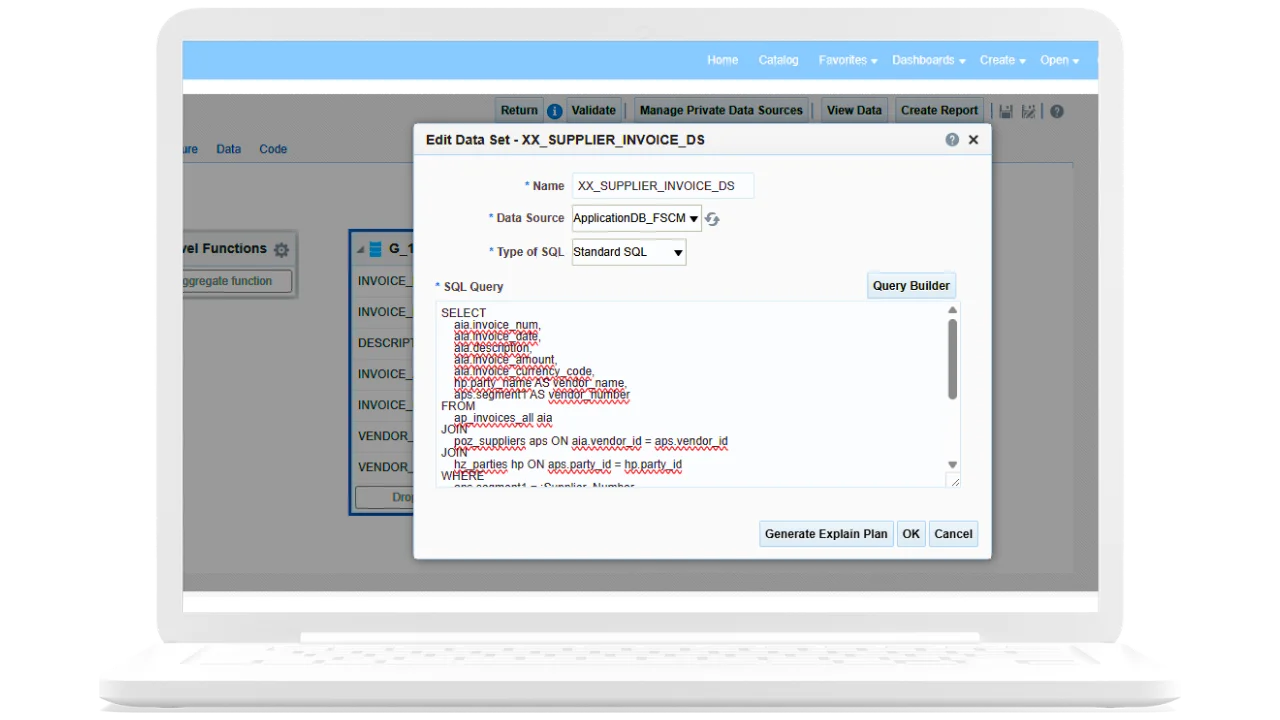
- Run Explain Plan/SQL Monitor: Use Query Builder’s “Generate Explain Plan” or “SQL Monitor Report” for each dataset to analyze physical and logical bottlenecks.


- Avoid Full Table Scans: Write SQL that benefits from indexes, avoid functions on indexed columns, add explicit WHERE conditions, and avoid leading wildcards in LIKE.
- Optimize Joins: Limit join conditions to only those necessary, eliminate circular joins and redundant tables, and always join _TL tables with a language filter to avoid row explosion.
- Parallelization: In on-prem/cloud multiprocessor environments, enable BI Publisher FOP and report “bursting” multithreading for increased parallel throughput
Note: For Financial reports, merging GL Lines and GL Balances datasets, and filtering GL_JE_LINES by indexed PERIOD_NAME, can materially improve speed.
Also Read: Oracle Fusion Ad Hoc Reporting Made Easy with CloudSQL
Optimize Runtime Settings
Increase BI Publisher runtime configuration within safe Oracle guidelines:
- Max Data Size: Default 300MB (XML) can go up to 1GB, but only if necessary.
- Memory Threshold: Default 500MB, recommend cautious moves toward 2GB for large extracts, considering stability.
- SQL Query Timeout: Default 600s; Oracle SaaS allows up to 1800s for offline reports, though online execution remains at 500s for server stability.
- Data Caching: Enable only when report parameters/data repeat predictably; disable for high frequency/integration jobs to prevent overflow.
Fine-tuning runtime settings like these form a key step in Oracle BI Publisher performance tuning.
Debug with Log Analysis
- BI Publisher Logging: Engine logs capture each stage, including data fetch, transformation, template/XSL-FO rendering, which helps isolate bottlenecks.
- Audit & Diagnostic Reports: Use BIP Audit tables (since Fusion 19B) to report detailed runtime and error metrics. Analyze “bipublisher.log” for dataset-level timings, output size, template time, query time, and user context.
- Trace SQL Executions: OTBI/BI Publisher log files (including NQQuery.log) enable tracing from logical to physical queries, allowing for the identification of mismatches or performance regressions.
Also Read: Running your First SQL with CloudSQL
Validate Using Oracle Fusion Tools
- Report Audit Tool: Enables tracking execution time, SQLIDs, row counts, error rates, and is vital for identifying regressions, spikes in concurrency, or dataset-level outliers.
- Data Model Validation: Use the “Validate” tool in Data Model Editor for design patterns, missing joins, or misapplied filters. Always re-validate for each new Oracle release, as rules and checks are regularly enhanced.
- SQL Monitor Reports: Generate these within Data Model Editor to check for SQL plan stability, join cardinality, and query costs, ensuring plans remain optimal even as data grows or shapes shift.
These validations are also vital when handling Oracle fusion data export jobs, where large datasets can impact runtime.
Troubleshooting Anecdote (Community Insight)
It is common for a report that executes in an SQL Editor like CloudSQL in less than 10 minutes to take over 2 hours within BI Publisher. Causes include:
- Use of different session/environment settings.
- Dynamic SQL changes (e.g., bind variable handling or security predicates).
- Plan differences due to variable data volumes or out-of-date stats.
Many users face such mismatches when they create BI publisher report designs without considering environment-level constraints. To troubleshoot, capture the actual SQL issued by BI Publisher, compare execution plans, and validate if optimizer hints, binds, or filters diverge from what is run in the database tool.
Also Read: Self‑Service SQL for Oracle Fusion: Enable Business Users
Summary Table of Best Practices
| Optimization Area | Recommended Action |
| Data Models & SQL | Avoid SELECT *, use column aliases, push WHERE filters down to SQL level |
| SQL Tuning | Use EXPLAIN PLAN, eliminate full scans, monitor with SQL Monitor |
| Runtime Configuration | Use EXPLAIN PLAN, eliminate full scans, and monitor with SQL Monitor |
| Log Debugging | Enable BI Publisher and server logs, analyse each pipeline stage |
| Parallel Processing | Enable FOP/bursting multithreading on qualified hardware for throughput |
Special Notes
- Always test changes in a lower (DEV/TEST) environment before moving to PROD.
- Be cautious with configuration increases, memory, timeout, or file size. Oracle SaaS places hard limits for cluster stability and does not recommend raising them without thorough justification.
- Document and monitor changes made to critical financial or high-frequency integration reports, as these are most vulnerable to performance drift. This documentation ensures that Oracle BI Publisher performance tuning remains consistent and measurable across environments.
Also Read: How to Connect to Oracle Fusion Database for SQL Queries?
Frequently Asked Questions (FAQs)
How do I reduce BI Publisher memory errors?
Apply stricter dataset filters, remove unused joins, consolidate results with merged SQL, and avoid outputting large raw datasets. Always use data size and timeout limits set at the system level
What is the optimal size for data models?
Minimize to only required datasets and columns. Consolidate parent-child sets, use SQL pruning, and exclude unused/remnant datasets.
How do I trace slow SQL executions in BI Publisher?
Enable audit logging, review BIP Audit tables, SQLIDs, and Execution Times, and compare explain plans with those in SQL Developer.
Does enabling multithreading help performance?
Yes, where hardware and report design allow it, enabling FOP and bursting multithreading can significantly improve batch processing and concurrent job throughput.